Iran Posed a Threat. Was War the Only Answer?
In the final days before the United States and Israel attacked Iran, Washington faced a genuine security problem: an Iranian nuclear program that inspectors could no longer fully monitor, a large stockpile of highly enriched uranium and a missile force capable of striking American troops throughout the Middle East. At the same time, diplomacy remained active, U.S. intelligence reportedly disputed one of President Donald Trump’s central claims about the missile threat, and the chairman of the Joint Chiefs was warning about the risks to American forces if a limited strike became a larger war.
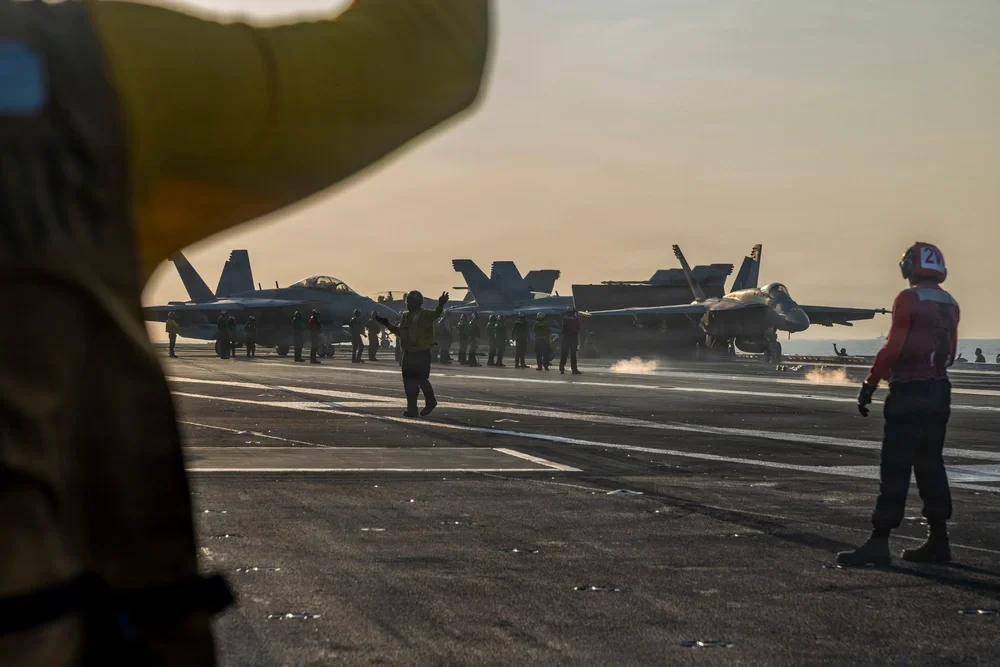
An F/A-18E Super Hornet prepares to launch from USS Abraham Lincoln in the Arabian Sea, Jan. 29, 2026.
Credit: U.S. Navy photo by Mass Communication Specialist Seaman Daniel Kimmelman / DVIDS
Assessment cutoff: February 27, 2026. This article evaluates the decision to go to war using only information available BEFORE the first U.S. and Israeli strikes. Later reporting is used only to determine whether known prewar risks were adequately anticipated and addressed.
This assessment is necessarily limited by the public record. The president and other senior officials had access to classified intelligence that remains unavailable, and it is possible that they possessed information that has never been disclosed. That possibility cannot be ruled out. But no subsequently disclosed U.S. intelligence reviewed for this article has established that Iran had decided to build a nuclear weapon or was approaching an imminent capability to attack the U.S. homeland before the war. Public intelligence assessments and reporting based on classified assessments therefore remain significant evidence of what Washington understood about the threat at the time.
On February 26, with American military power massing around Iran and the possibility of war hanging over the negotiations, U.S. and Iranian representatives completed another round of talks in Geneva. They did not produce an agreement, and the two governments remained divided over some of the most difficult questions in a dispute that had lasted decades, including whether Iran would retain any domestic uranium-enrichment capability and what sanctions the United States would lift in return for nuclear restrictions.
But the negotiations had not broken down. Iranian Foreign Minister Abbas Araqchi described the discussions as some of the most serious exchanges Iran had held with the United States, Oman said significant progress had been made, and technical discussions were scheduled for the following week in Vienna. Reuters reported that the talks ended without a breakthrough, but with both sides planning to resume negotiations after consultations in their respective capitals.
Two days later, the United States and Israel went to war with Iran.
Today, the casualties, economic consequences, battlefield successes and strategic setbacks can influence how that original choice appears. An assessment of the decision itself requires a narrower lens: what could American policymakers reasonably have known before the attack?
That public record shows an Iran that presented legitimate and potentially severe national-security challenges. It also shows that the United States entered the conflict with substantial uncertainty about Iran’s intentions, diplomatic alternatives that had not yet been exhausted, and unusually specific warnings about how Iran could retaliate—from missile and drone attacks against American bases to disruption of one of the most important shipping routes in the world.
The threat was real. Its immediacy was less clear.
Iran’s nuclear program presented the most obvious case for action. The International Atomic Energy Agency had lost access to three critical facilities—Natanz, Fordow and Isfahan—after they were bombed by the United States and Israel in June 2025. By January, IAEA Director General Rafael Grossi was publicly warning that the resulting inspection impasse could not continue indefinitely. Iran had not provided the agency with a required accounting of what happened at the sites or to an estimated 440.9 kilograms of uranium enriched to 60 percent, material that could, if enriched further, provide enough fissile material for multiple nuclear weapons.
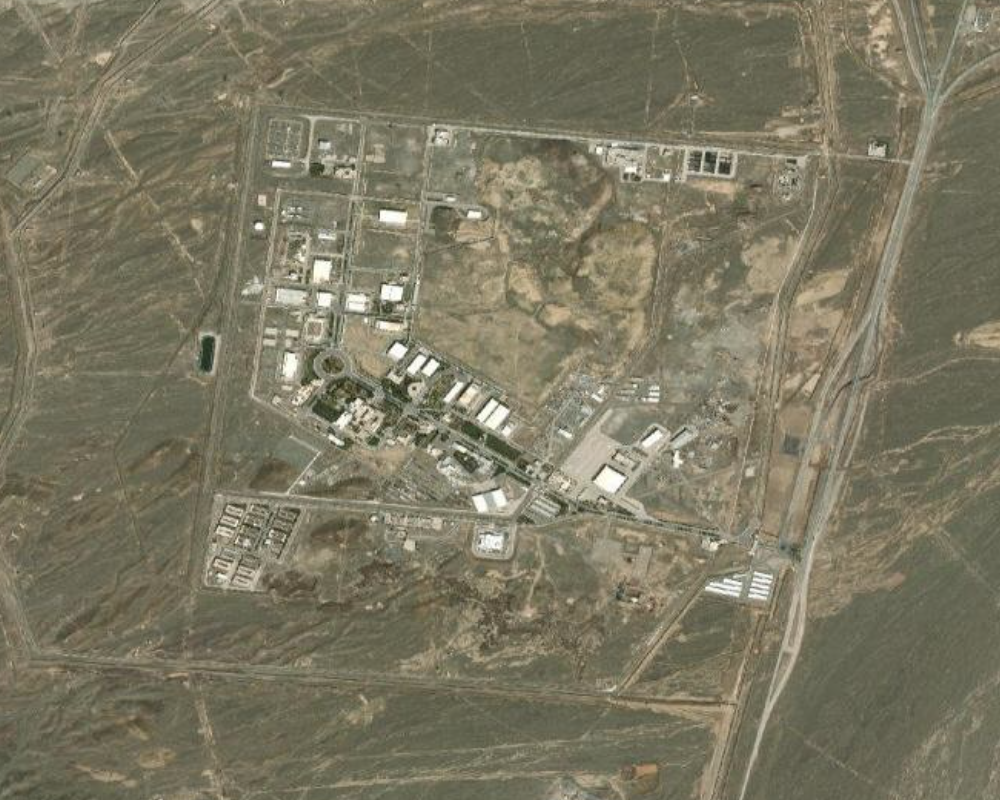
NASA satellite imagery of the Natanz nuclear facility area, June 19, 2025.
Credit: NASA LANCE FIRMS / ESDIS
That was not a trivial threat. Sixty-percent enrichment is far beyond what is ordinarily required for civilian nuclear power and technically much closer to weapons-grade material. Iran’s inability—or unwillingness—to account for that stockpile left inspectors with a major blind spot and gave Washington good reason to worry about what Tehran might be able to do outside international monitoring.
The uncertainty, however, cut both ways. The most recent public assessment from the U.S. intelligence community continued to state that Iran was not building a nuclear weapon and that Supreme Leader Ali Khamenei had not authorized the weapons program suspended in 2003. Intelligence officials simultaneously warned that Iran’s enriched-uranium stockpile had reached unprecedented levels for a country without nuclear weapons and that the longstanding taboo inside Iran against openly discussing them appeared to be weakening.
Those conclusions described a dangerous threshold state, but they also drew an important distinction between possessing the capability to produce a nuclear weapon and making the political decision to build one. Publicly available U.S. intelligence established the first. As of February 27, it had not established the second.
On February 20, the Arms Control Association argued that Iran’s principal enrichment facilities damaged in 2025 remained idle and that there was no public indication of active weaponization sufficient to demonstrate an immediate nuclear emergency. The organization opposed another attack and warned that additional bombing could further impede efforts to locate Iran’s enriched uranium and restore international inspections. Its conclusions represented the position of an arms-control advocacy organization rather than the U.S. intelligence community, but the underlying dilemma was real: the previous bombing campaign had damaged Iran’s nuclear infrastructure while also reducing the world’s ability to monitor what remained.
Washington therefore faced a genuine intelligence gap rather than a clear picture of an Iranian sprint toward a bomb. Iran could have been concealing activities inspectors could no longer see, but there was no publicly demonstrated evidence that Tehran had made the decision to immediately construct a weapon.
Another component of the administration’s case encountered a more direct challenge from American intelligence. Trump warned that Iran was approaching the ability to develop missiles capable of striking the United States. On February 27, Reuters reported that three people familiar with classified assessments said current U.S. intelligence did not support that assertion. Intelligence agencies, according to the report, had not changed a 2025 Defense Intelligence Agency estimate that Iran might not produce a militarily viable intercontinental ballistic missile from its existing space-launch technology until at least 2035.
That did not diminish Iran’s existing missile threat. U.S. intelligence assessed that Iran already possessed ballistic and cruise missiles and drones capable of reaching American troops and allies throughout the Middle East, and Tehran had demonstrated its willingness to use them. The distinction was geographic: Iran already posed a substantial threat to U.S. forces in the region, but the intelligence reportedly did not support the claim that it was approaching a comparable capability against the continental United States.
For an assessment of whether military action was urgent, that difference mattered.
Washington still had another path open
The most difficult fact to reconcile with the timing of the attack was the status of diplomacy.
Washington had legitimate reasons to remain skeptical. Iran had a long history of disputes with international inspectors, unresolved questions about undeclared nuclear activity and nuclear negotiations that repeatedly stalled or collapsed, giving American officials reason to consider the possibility that Tehran could use diplomacy to buy time, preserve leverage or avoid an attack without accepting meaningful long-term restrictions.
But those concerns were different from evidence that negotiations had failed.
On February 22, a senior Iranian official told Reuters that Tehran was prepared to consider sending roughly half of its most highly enriched uranium out of the country and diluting the remainder. Iran was also willing to discuss participation in a regional enrichment consortium and extensive IAEA monitoring. In exchange, Tehran wanted sanctions relief and American recognition of what it described as its right to peaceful uranium enrichment. Washington continued to demand zero enrichment, leaving a major unresolved dispute between the two sides.
The proposals were not commitments, and the United States had ample reason to question whether Iran would ultimately accept or comply with a verifiable agreement. Yet four days later the two sides were still talking, Oman was reporting progress and another round was expected.
The alternative to military action was therefore not simply allowing Iran’s nuclear program to proceed unchecked. Washington could continue negotiations backed by sanctions, military deterrence and demands for renewed inspections while pursuing an agreement that removed or diluted Iran’s most enriched uranium. That approach carried serious risks: Iran might reject a final agreement, violate its terms or use diplomacy to strengthen its position. But military action contained its own uncertainty—most notably whether bombing Iran could permanently solve the nuclear problem at all.
Military action could significantly damage Iran’s nuclear program by destroying facilities, equipment, records and, potentially, the personnel needed to operate or rebuild them. But permanently eliminating a program developed over decades would require more than destroying known sites. Iran had accumulated technical expertise, industrial capacity and a network of scientists and engineers that could allow at least portions of the program to be reconstructed over time. That created a second risk: if Iran survived the attack with enough of its nuclear program intact, its leaders could conclude that actually building a nuclear weapon was the best way to deter another attack. Nuclear-policy specialists were making that argument publicly before the war.
The retaliation problem was already visible
The United States possessed overwhelming conventional military advantages over Iran, but the more consequential uncertainty was not whether Washington could destroy Iranian targets—it was how Iran would retaliate, where it would strike and how quickly that retaliation could widen the conflict.
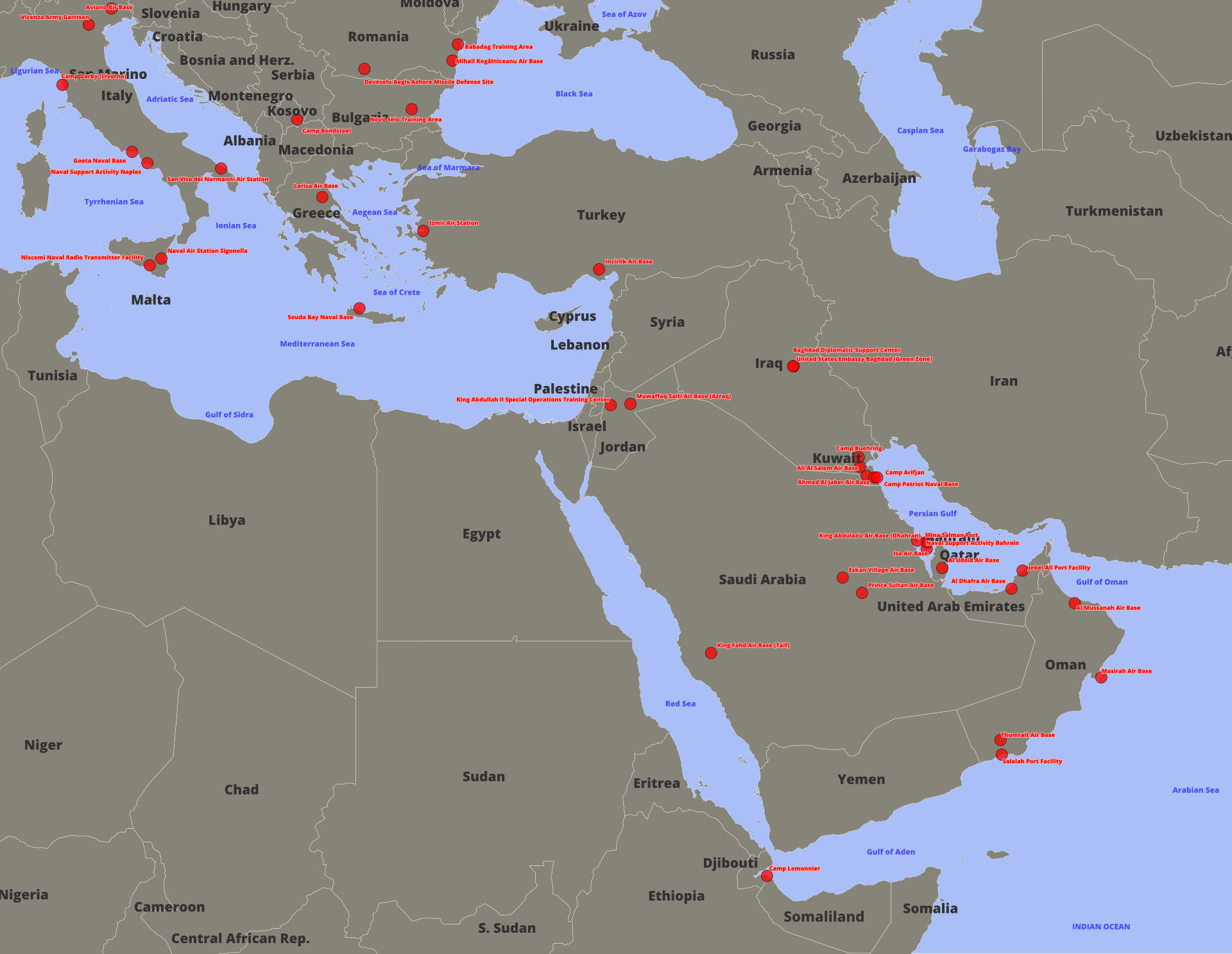
U.S. military bases and facilities across the Middle East before the war. Many installations in the Gulf were within range of existing Iranian missile and drone systems.
Credit: Map by Wikideas1 / Wikimedia Commons
By mid-February, military planners were preparing for the possibility of operations lasting weeks. On February 23, The Washington Post reported that Gen. Dan Caine, chairman of the Joint Chiefs of Staff, had cautioned Trump and other senior officials that depleted stocks of critical munitions and insufficient allied support would increase both the difficulty of an Iran campaign and the danger to American personnel. Two of the systems most important for defending U.S. troops from Iranian ballistic missiles—Patriot and THAAD—were among the capabilities under strain after heavy demands elsewhere.
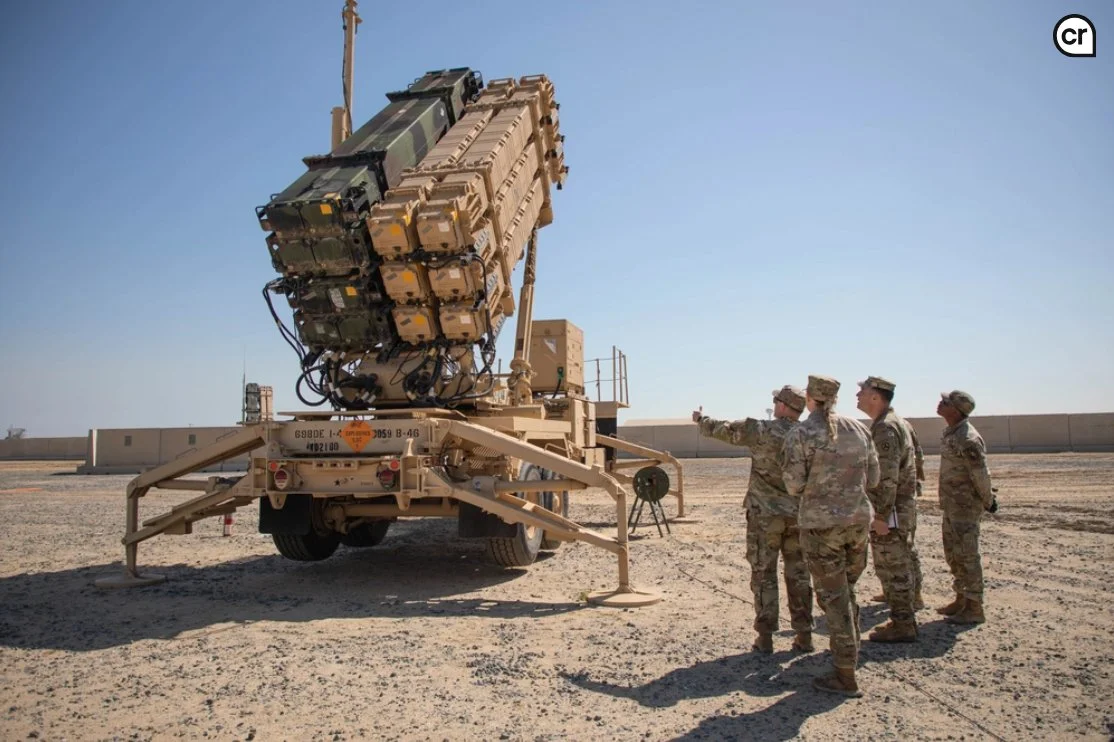
U.S. soldiers with a Patriot air-defense system in the U.S. Central Command area of responsibility, Feb. 19, 2025. Patriot and THAAD interceptors were among the systems needed to protect American forces from Iranian missile attacks.
Credit: U.S. Army photo by Staff Sgt. Clara Harty / DVIDS
The threat to American bases was not hypothetical or difficult to identify. A Gulf ally had warned U.S. officials by early February that Iran retained short-range missiles capable of hitting more than a dozen American bases and tens of thousands of U.S. troops in the region. A former Pentagon official told The Washington Post that Iran possessed more missiles than Gulf states had interceptors available to stop them and warned that the region’s dispersed, incompletely integrated air defenses could potentially be overwhelmed by larger attacks.
Iran was also saying publicly what it intended to do. On February 7, Iranian Foreign Minister Abbas Araqchi warned that if the United States attacked Iran, Tehran would retaliate against American military bases in the region. Iran had already demonstrated that capability: after the killing of Qassem Soleimani in 2020, Iranian ballistic missiles struck a base housing U.S. troops in Iraq, and after the 2025 American attack on Iranian nuclear facilities, Tehran fired missiles at Al Udeid Air Base in Qatar.
Washington did take protective measures. Aircraft and personnel were repositioned, defensive systems were moved into the region, and some forces were dispersed away from large bases judged especially vulnerable. Those steps matter because they argue against a simple conclusion that the Pentagon ignored the threat altogether; the more precise question was whether U.S. defenses and dispersal plans were sufficient for the scale and variety of retaliation Iran was known to be capable of launching.
Later reporting makes that question harder to dismiss. On March 1, an Iranian drone struck a tactical operations center at Port Shuaiba in Kuwait, ultimately killing six American service members and wounding dozens. A Washington Post investigation found that the prefabricated structure offered little protection against an overhead missile or drone strike, and at least 11 American military outposts were hit during the initial Iranian retaliation.
Subsequent reporting raised more specific concerns. Survivors told the Post that prewar force-protection assessments had recommended against positioning personnel at Port Shuaiba because of inadequate defenses and that commanders had received warnings that the facility could be an Iranian target. Soldiers said a requested counter-drone system had not been provided because assets were unavailable. Army Central defended the selection of the site, and a separate classified investigation examined relevant intelligence and air-defense issues; those findings have not been made public.
The available evidence therefore does not support a blanket conclusion that American forces went to war without preparation. It does support a more focused accountability question: when Iran’s ability and stated intention to attack U.S. bases were known in advance, were some troops left in positions whose defenses were inadequate for the threat the Pentagon expected?
Hormuz was not a theoretical risk
Descriptions of Iran’s ability to threaten the Strait of Hormuz sometimes treated closure as an extreme scenario—something Tehran might attempt only if a conflict became sufficiently desperate. But the vulnerability was well understood long before February 28, and Iran was demonstrating its leverage in real time.
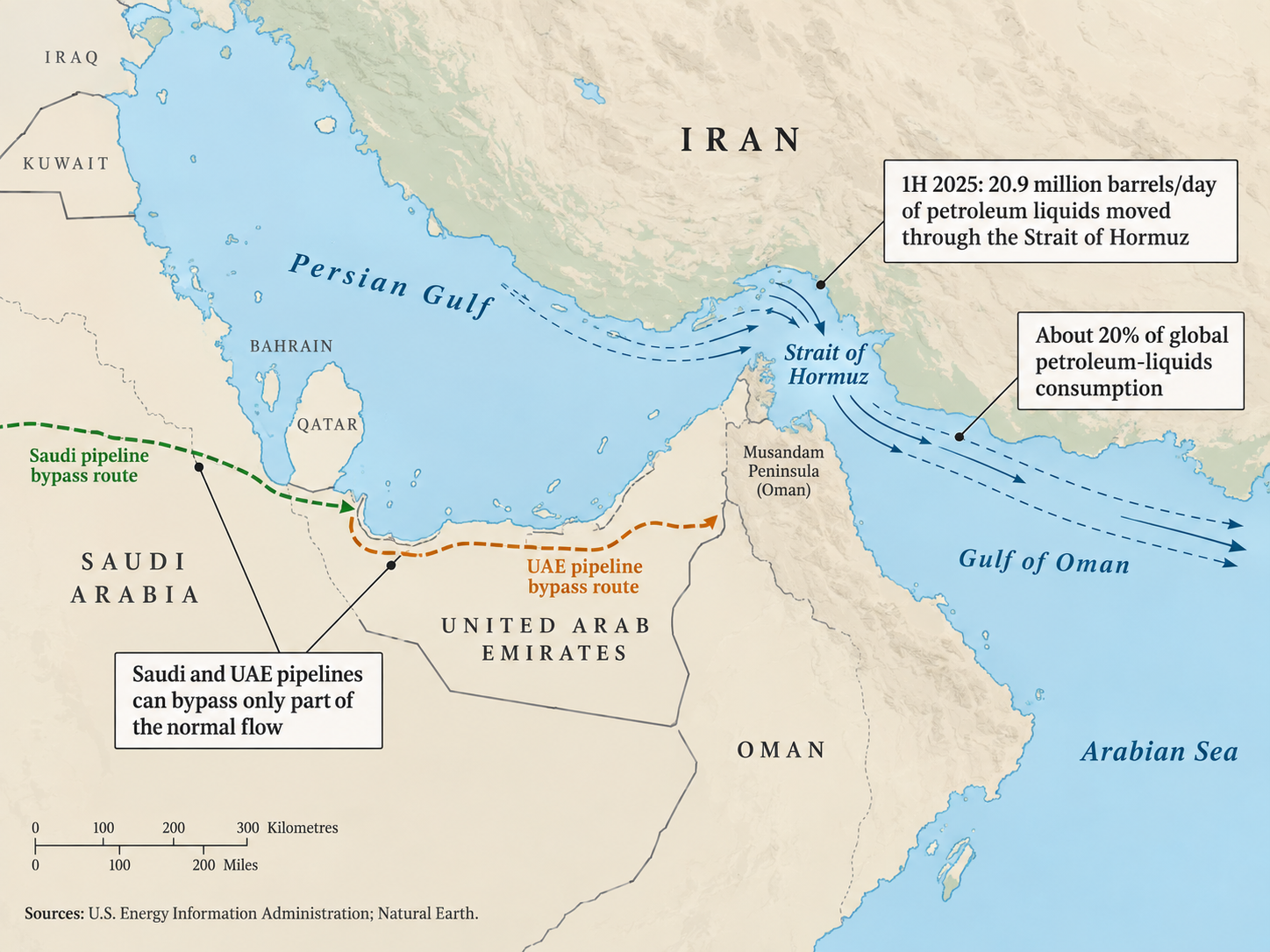
The Strait of Hormuz connects the Persian Gulf to the Gulf of Oman. Saudi and Emirati pipelines can bypass the strait, but their capacity can replace only a fraction of the oil normally moving through it.
Credit: Source: U.S. Energy Information Administration, June 2024.
The Strait of Hormuz is a narrow channel connecting the Persian Gulf to the Arabian Sea. In the first half of 2025, an average of 20.9 million barrels of petroleum liquids passed through it every day, equivalent to roughly one-fifth of global petroleum-liquids consumption and more than one-quarter of global maritime oil trade. Saudi Arabia and the United Arab Emirates maintained pipelines capable of bypassing the strait, but their available capacity could replace only part of the normal flow.
Iran did not need a navy capable of defeating the United States to threaten that traffic. For decades it had developed an asymmetric maritime strategy built around mines, coastal anti-ship missiles, drones, submarines and large numbers of small fast-moving boats. CSIS assessed on February 26—two days before the war—that Iran could respond to an American attack by laying mines, launching one-way attack drones or combining drones, fast-attack craft and anti-ship missiles against U.S. or commercial vessels. Such attacks would not need to produce a permanent physical blockade to have economic effects; they could make insurers, tanker operators and shipping companies unwilling to accept the risk of passage.
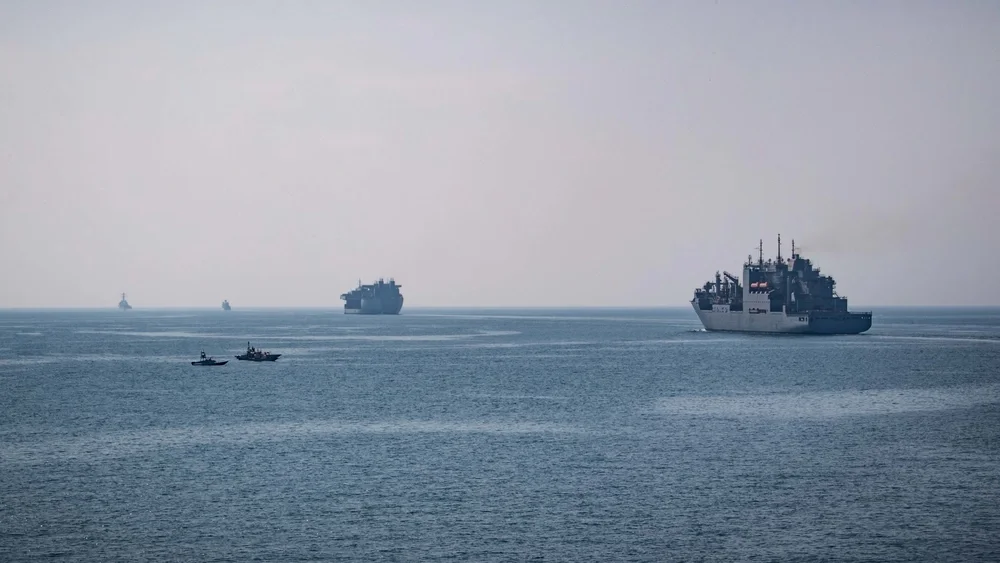
Iranian small boats pass near the guided-missile destroyer USS Jason Dunham and USNS Invincible during a transit of the Strait of Hormuz, Nov. 14, 2018.
Credit: U.S. Navy photo by Mass Communication Specialist 3rd Class Jonathan Clay / DVIDS
More strikingly, Iran was already demonstrating its ability to interfere with the waterway during the same month Washington was considering war. On February 17, Iranian authorities temporarily closed parts of the Strait of Hormuz for several hours while the Revolutionary Guards conducted military exercises. The episode did not prove that Iran could maintain a wartime blockade against American opposition, but it demonstrated its ability to interfere with traffic through the chokepoint and underscored a threat that analysts had been discussing for years.
The relevant prewar question was therefore never whether Iran could indefinitely seal Hormuz against the U.S. Navy; it was whether Tehran could make passage dangerous enough, for long enough, to disrupt global energy markets. Mines were particularly important because even the possibility that a shipping lane had been mined could require time-consuming clearance operations, while missiles and drones could threaten tankers, ports and naval vessels from the Iranian coastline. Commercial shipping decisions would ultimately be made not only by military commanders but by companies and insurers deciding whether the risk of passage remained acceptable.
This was one of the clearest foreseeable economic consequences of war. Iran was conventionally weaker than the United States, but geography gave it a mechanism for transmitting the costs of conflict far beyond the battlefield: disruption of Hormuz could affect crude oil, liquefied natural gas, tanker rates and ultimately fuel and transportation costs around the world. Whether Washington believed it could neutralize that threat quickly is a separate question; the public record does not support the idea that Iran’s ability to disrupt the strait was unknown or unexpected.
The region was warning about what a larger war could become
The warnings extended beyond missiles and shipping, and some came from governments that had spent years treating Iran as one of their principal security threats.
Saudi Arabia, Qatar, Oman, Turkey and Egypt were among the governments pushing for diplomacy and de-escalation. Their opposition was not necessarily based on sympathy for the Islamic Republic; Gulf governments had their own long record of confrontation with Tehran and remained concerned about its nuclear, missile and regional activities. What had changed was their assessment of the consequences of another war.
A February 19 Chatham House analysis described regional fears that an effort to overthrow the Iranian government could produce something more destabilizing than the government it replaced: state fragmentation, mass migration, radicalization, armed factions and a security vacuum in a country of roughly 90 million people. The analysis also noted that Iran lacked an organized, nationwide opposition clearly positioned to assume control of the state and that regime collapse could become inseparable from state collapse.
That concern complicated arguments for regime change. The Islamic Revolutionary Guard Corps was deeply embedded in Iran’s military, political and economic structure, meaning the fall of the clerical leadership would not itself determine what followed. Democratic transition was one possible outcome, but so were an IRGC-dominated successor, competition among armed factions, separatist conflict or the survival of the existing system in a more militarized form.
Foreign attack could also alter Iran’s internal politics in ways that were difficult to predict. Citizens can oppose their government while simultaneously opposing their country being bombed, allowing a government confronting domestic unrest to invoke nationalism, justify greater repression or portray political opponents as assisting a foreign enemy. None of those outcomes was certain, but neither was the assumption that military pressure would automatically strengthen the Iranian opposition.
Regional reluctance mattered operationally as well. American military power in the Middle East depends partly on access to bases, ports, airspace, logistics networks and allied missile defenses, and Gulf governments were reluctant to allow their territory to be used to attack Iran precisely because Tehran had threatened retaliation against countries that assisted the operation. Caine’s reported concerns about allied support therefore were not merely diplomatic; they affected both the conduct of the campaign and the defense of American personnel.
Congress, meanwhile, had not specifically authorized a new war. Before the attack, Democratic Sen. Tim Kaine and Republican Sen. Rand Paul were pursuing a War Powers resolution requiring congressional authorization for hostilities against Iran, while Republican Rep. Thomas Massie and Democratic Rep. Ro Khanna were advancing a similar effort in the House. Presidents of both parties have asserted substantial authority to conduct limited military operations without prior congressional approval, but that authority becomes more contested when a limited operation develops into sustained warfare. The constitutional question therefore intersected with the military one: planners were preparing for a campaign that could last weeks while Congress had not authorized one.
What the evidence supported on February 27
The prewar record supports two conclusions at once: Iran posed a serious threat, but the publicly available evidence did not establish that war was the only remaining response.
Iran possessed a large stockpile of highly enriched uranium that inspectors could no longer fully account for, had rejected important American nuclear demands, maintained a formidable missile arsenal and possessed the ability to strike U.S. personnel and allies throughout the region. The intelligence community also warned that discussion of nuclear weapons inside Iran was becoming less taboo. Continuing diplomacy therefore carried real risks: negotiations could fail, Iran could refuse meaningful restrictions, and Tehran could preserve capabilities that Washington considered increasingly dangerous.
But by February 27, the evidence did not show that Iran was known to be racing toward an imminent nuclear weapon or that nonmilitary options had been exhausted. The U.S. intelligence community continued to assess that Tehran had not authorized a nuclear weapons program. One of the president’s arguments about Iran’s emerging ability to threaten the American homeland was reportedly inconsistent with current intelligence. Negotiations were still underway, Iran had placed potentially significant nuclear concessions on the table, and another round of talks was expected.
The risks of war were also visible before the first strike. Iran had openly threatened American bases, and U.S. officials and regional governments knew its missiles and drones could reach them. The chairman of the Joint Chiefs was reportedly raising concerns about the defensive weapons available to protect American forces, while Iran’s ability to disrupt shipping through the Strait of Hormuz had been analyzed for decades and was being demonstrated in military exercises less than two weeks before the attack.
Washington was therefore choosing between two uncertain paths. Diplomacy risked delay, deception and failure. Military action offered the possibility of destroying capabilities that negotiations might never eliminate, but it also carried foreseeable dangers: retaliation against American forces, escalation beyond the original mission, reduced visibility into Iran’s nuclear program, disruption of a critical global energy route and instability inside a country whose political future could not be predicted with confidence.
On February 27, the nuclear problem remained unresolved, but diplomacy had not ended. The United States and Iran were still negotiating, and no one could know whether another round of talks would produce an agreement or simply postpone a confrontation.
The bombing began the next day.
—by Johnathan Days